Machine
How an episode is made.
Six stepsPick · Write · Storyboard · Make · Check · Ship
Models do the work on rules people set; every result feeds the next episode. Here is each step, with real material from the line.
01Pick
Candidates come from anime and from the threads where people argue about them — more than 26,000+ scenes from 750+ works. The score is out of 100 and fitted to how our own past episodes did in their first 72 hours. Two things carry it: does the scene make you ask “wait, that works?”, and is there a physical object on screen to draw.
02Write
Claude writes the Korean script first, then the Japanese and English versions as scripts of their own. We compared scripts from two models with the names hidden; the same one was chosen 8 times out of 8.
03Storyboard
Every cut is fixed on paper first — size, camera move, timing, the line it carries and the prompt that will make it. Generation costs money; fixing a cut after it is rendered is already too late.
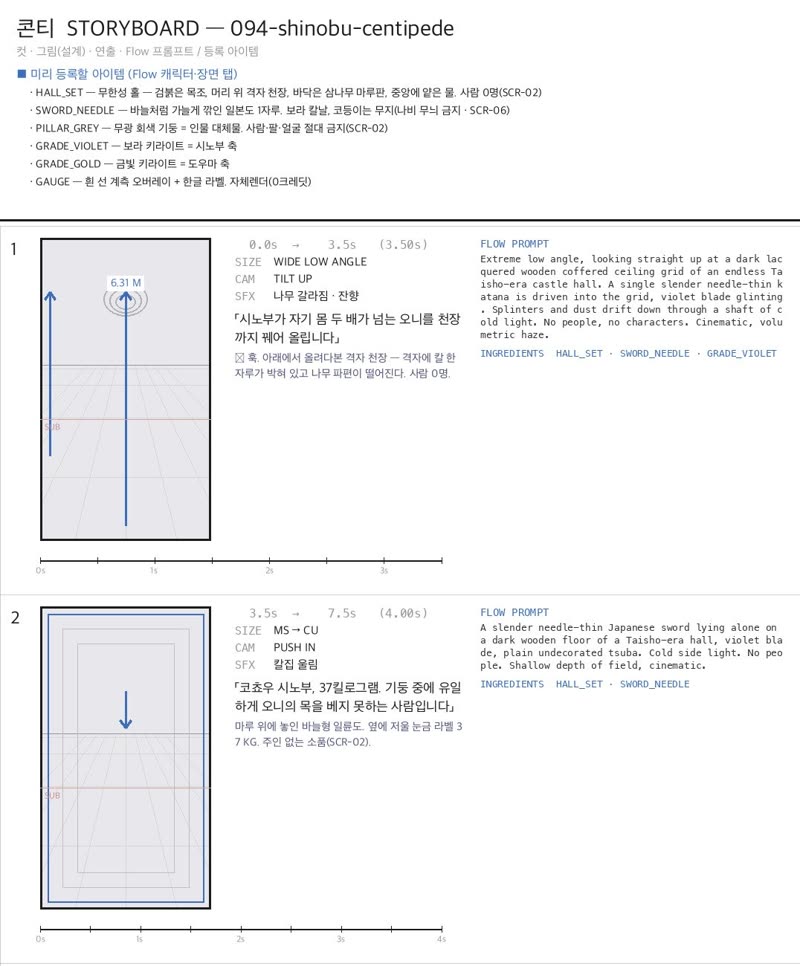
A real conte sheet (episode 094). Left: the cut drawn in code. Right: the shot prompt. 04Make
Most cuts come from Google Flow, prompted shot by shot. Cuts that must show the arithmetic exactly — gauges, comparisons, forces — are rendered in code instead. Then captions, numbers, narration and music go on top.

Raw Flow output (episode 091). 
The same moment as published — caption, figure, channel stamp. Shot prompt, as writtenSHOT 1 (0-2.5s): An aged monochrome photograph on an ivory sketchbook page shows a 1920s racing flying boat floating on still water. The camera glides slowly right as teal watercolor begins to seep into the hull at the waterline of the photograph.
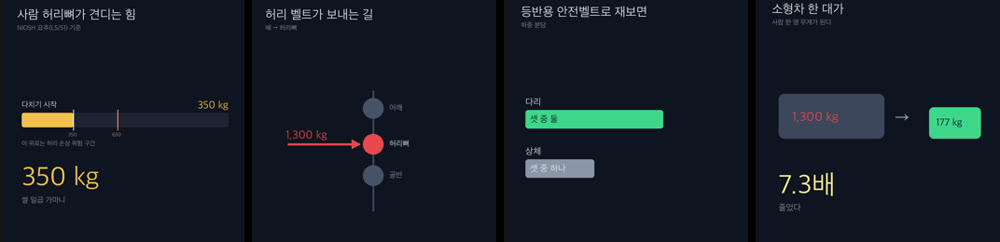
Cuts rendered in code (episode 099): forces on the spine, compared in kilograms. 05Check
Before upload, every line is laid out with three frames from its cut, and a vision model reads the sheet for broken frames, wrong text and characters off model. A person skimming thumbnails cannot see a one-frame defect — we missed one that way once, so this step is never skipped.
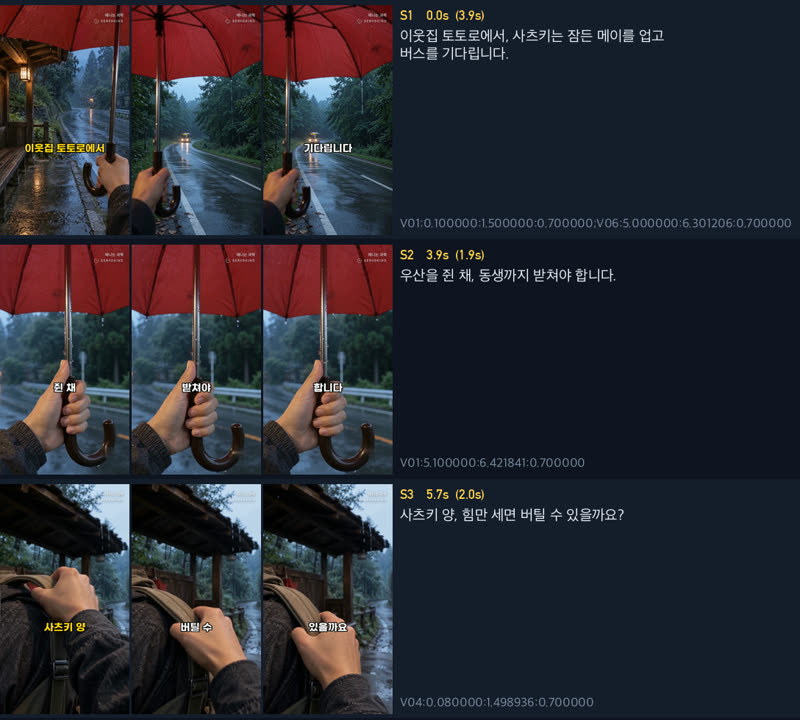
A review sheet (episode 445): each line, its timing, three frames. 06Ship
Episodes go out through the official APIs — Korean, then Japanese, then English — with AI-content disclosure on. If an earlier language fails, the later ones stop. Every upload is reopened at its public address, and comments from all six accounts go into one ledger that feeds the next pick.
Tools
| Picking | Gemini (Google) | scouts scenes and community threads, ranks candidates |
| Script | Claude (Anthropic) | writes every script we publish, in all three languages |
| Storyboard | our own conte sheets | fixes every cut before anything is generated |
| Video | Google Flow (Veo) | most cuts, from a written shot list and a starting frame |
| Stills | Gemini image generation | starting frames and cover backgrounds |
| Charts | Remotion · Blender · physics sims · pixel art | cuts that must show the arithmetic exactly, rendered in code |
| Footage | real-world clips | when the real object or place has to be seen |
| Voice | MiniMax and other speech synthesis | narration in each language |
| Music | Google Lyria · MiniMax Music | a track made for each episode’s mood |
| Captions | whisper.cpp | word-level timing from speech recognition |
| Edit | FFmpeg | assembles cuts from an edit list, burns in captions, levels audio to −14 LUFS |
| Review | Gemini vision | checks every cut and cover — never the model that made it |
| Publish | YouTube Data API · Instagram Graph API | official APIs only, with AI-content disclosure turned on |
| Glue | Claude Code | wrote most of the tools above, runs them, fixes them when they break |
What we learned
If there’s nothing to draw, nobody watches.
Every episode that did well had something physical pulling off a stunt; every one that didn’t was an abstract explanation. “Is there an object to draw?” became one of the two weights in our score.
Moving pictures beat our charts.
Across the 93 episodes we rated best, cuts rendered in code were 2.3% of all cuts; across the 66 we rejected, 8.7%. We now cap code-rendered cuts at about one per episode and keep them for the moment where the exact number matters.
Viewers fix the arithmetic.
In late August a Japanese viewer asked whether our 160 km/h premise was too fast. It was. Since then every comment is read — more than 600 so far, foreign-language ones translated and sorted into requests, corrections and error reports.
Easy to make and worth watching pull apart.
Our first score rewarded scenes that were safe to produce. Those did worse — the correlation reached −0.8. We took production ease out of the score.
One mistake is not a rule.
At first every piece of feedback became a rule; they grew into the hundreds and some quietly stopped reaching the model. Now a problem becomes a rule only the second time it appears, and the rules have a budget.
Some buttons stay human.
For the first two months, every episode went out only after a person approved that episode. Automatic publishing was switched on in October 2026, and only for fixed time slots.